1.01.2008

The Rubik's Sub Takes Gold at Blog.pcnews.ro

Thanks Raluca!

10.25.2007

The Rubik's Cube Subwoofer Goes International!!

The Netherlands:
I Am The Media - Thanks Joery!!

The UK:
DCEMU - Thanks Shrygue!

France:
Thanks to Gizmodo France!

Japan:
Thanks Netallica (Netarika)!!

...and of course Gizmodo Australia!

10.17.2007

The Rubik's Cube Subwoofer makes it to Gizmodo.com!!

Thanks for the opportunity Sean!!

10.11.2007

The Beginning...

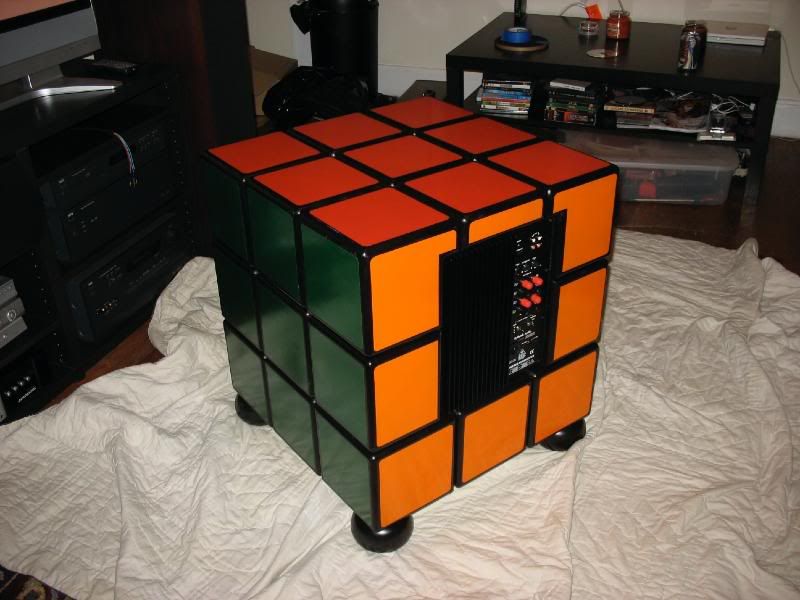
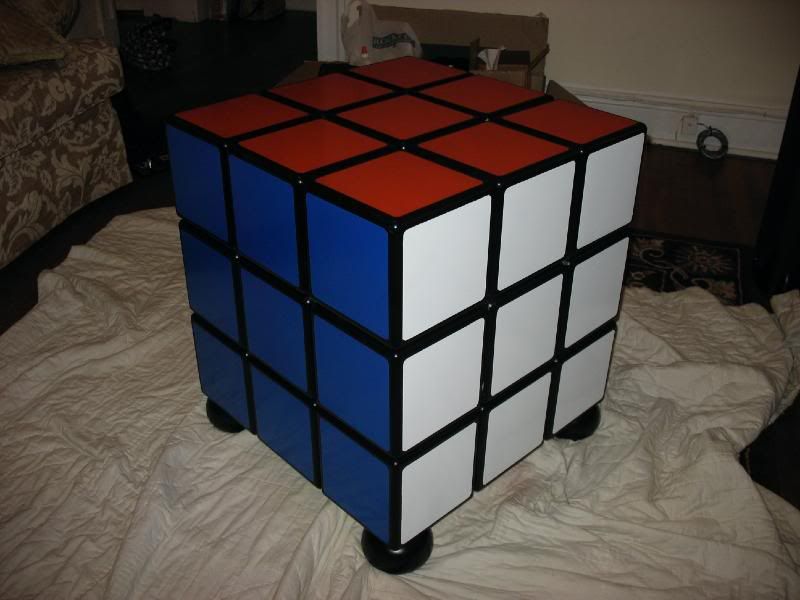
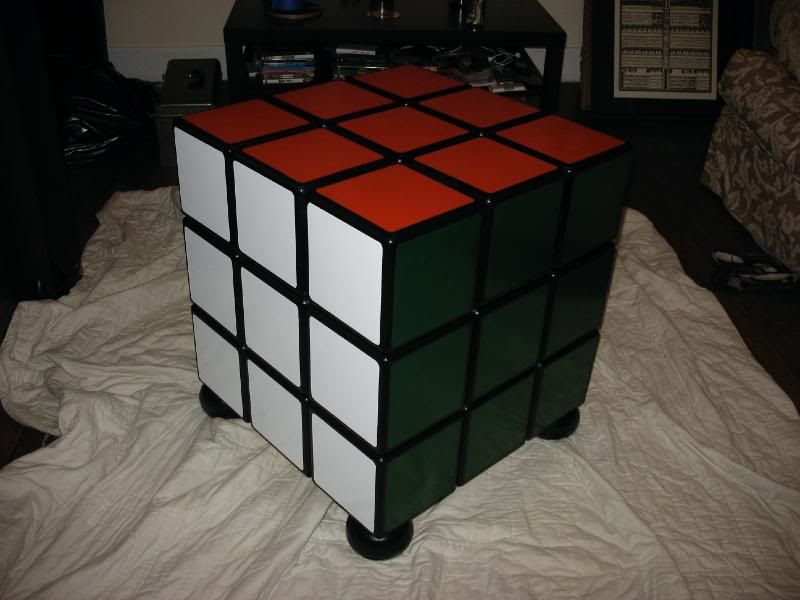
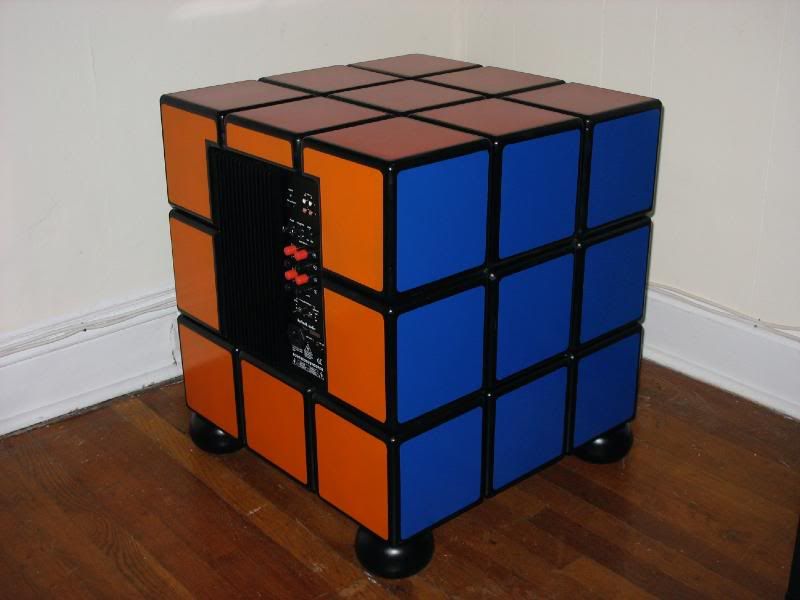
On July 10th 2007 I began making a personal addition to my home theatre's sound system - 80 days later I completed it: the world's first Rubik's Cube subwoofer...

In case you are unfamiliar with subwoofer construction, Brian Steele runs a great site - the DIY Subwoofer Page. On it, you'll find advice, calculations, templates, and examples of those who have dared before you. Since there are literally hundreds of sites, software programs, and books on the subject matter I’ll summarize my final specs below:

Sealed Enclosure: 3 Cu. Feet
Driver Diameter: 15", Aluminum Cone
Outer Enclosure: 3/4" MDF Shell with 3/4" MDF 'tiles' overlaying it, forming the Rubik's Squares
Reinforcement: 1 Y/Z-Axis piece of 3/4" MDF, cut to allow driver. 1 X/Y-Axis piece of 3/4" MDF, cut to allow driver and Plate Amp. 1 Z-Axis piece of 3/4" MDF, cut to allow Driver. 1 full piece of 1/2" MDF at top. 1 Cut piece of 3/4" MDF on bottom.
Total Box measurements: 20.75" Wide, 20.75" Tall, 20.75" Long
Tile size: Face: 7.5" X 7.5", Cube: 7.5" X 7.5" X 7.5"
Total Measurements: 22.5" Wide, 25.5" Tall (w/ 3" feet), 22.5" Long
Total Weight w/o Speaker, wiring, Poly-fil, Amplifier: ~98 lbs.
Total Weight: ~144 lbs.

It's a beast, I must say, but before we begin how about some background information? My current system utilizes 2 Paradigm v3.0 Studio 100s (fronts), 1 CC-590 center, and 2 Studio 20s for 5.1 surrounds. Driving all that is an NAD T773, biamped with 2 NAD C272s for the fronts and discrete 7.1 inputs biamping the 20s - Long live the Canadian sound! Likewise, when I finally moved into my new apartment with space for a television (that's a luxury in Boston) I wanted the extra kick for DVDs - what HT is complete without a sub? I'll admit I’m a bit of a purest and can’t stomach the thought of attaching an external sub to my stereo so my search began for something that could rock the 60hz range in movies but neither force me to rewire every time I want to play a CD...

Being a huge fan of my Paradigms, I naturally went to the accompanying model for my Studio 100s - the Direct Servo 15. Despite making a great sub, I also played around with the option I eventually went with - making one. Reasons for this were two-fold - I hadn't taken on any art pieces in a while and just having dropped first, last, security, etc for the new place I didn't want to make a large purchase (insert your Alanis Joke here). Long story short, I chose to go with a Rythmik Audio Servo-15. One visit to Rythmik Audio's website and you can see that these guys aren’t messing around.

If you're completely new to building (Hi Mom!), here's what you need to know in order to make sense of the pics below: A sealed Sub system (this one) is comprised of air-tight box, a large (usually 8" or more) driver and an amplifier to power it. The driver vibrates the air inside the box which causes low-end sound waves to form. Since the box is being shaken so violently it is extremely important that box be very well braced - as in you should be able to stand on it and jump - it should also be heavy enough that it doesn't move. The interior size of the box is a carefully calculated volume of air that must be present along with the interior support.

So, after 2 weeks of drawing up plans, I finalized my measurements and got started...
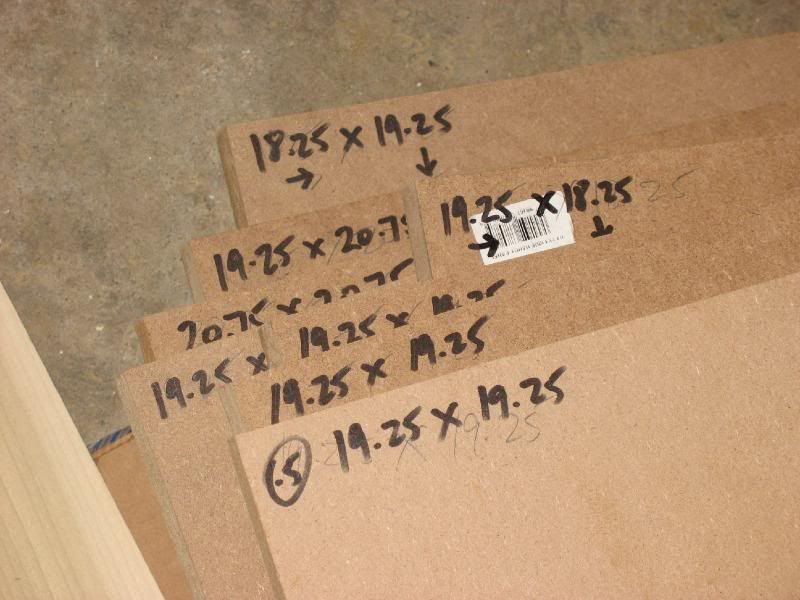
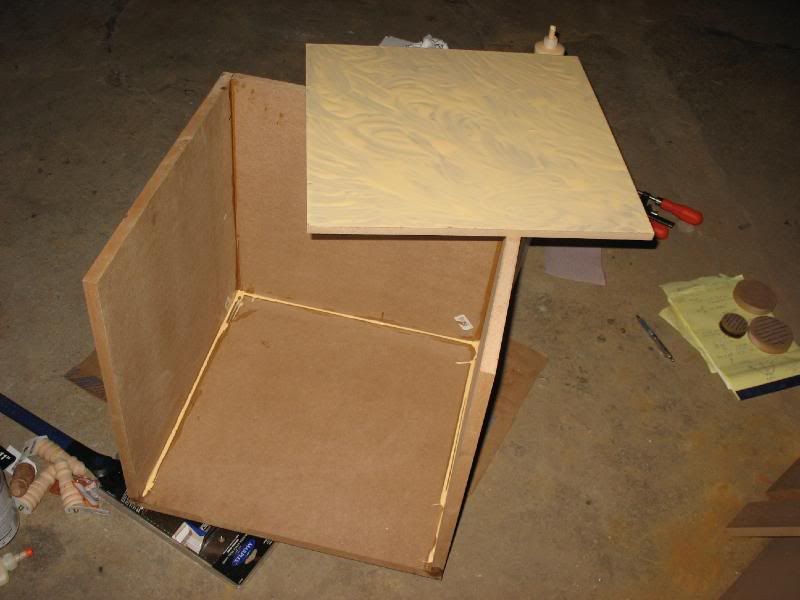
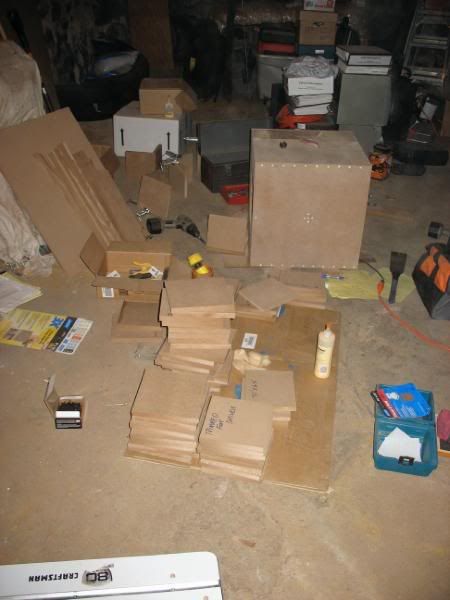
The ceremonial first picture. I can't emphasize this enough: work everything out on paper first - the yellow pad there is full of calculations that I referenced every step of the way. Also I’ll take this time to mention I built this in my old (rented) apartment, the space you see here is my landlord’s basement, haha.


My design calls for the outer 3/4" MDF to overlap in certain places and underlap in others. I'm using all butt-joints and reinforcing the bottom with a second layer of 3/4" MDF and the top with an additional 1/2" sheet of MDF. The pieces have been marked for easy reference. Notice on the first piece you'll see '.5' corresponding to my 1/2" MDF and next to that 19.25" X 19.25". This corresponds to the outer 3/4" MDF in which the .5" sits - my original calculations called for a total size of (19.25x19.25+.75+.75) 20.75" X/Y/Z for .25" thickness overhang (from the Rubik’s tiles) surrounding the shell. This design was changed in tiling stage and I'll explain why below!


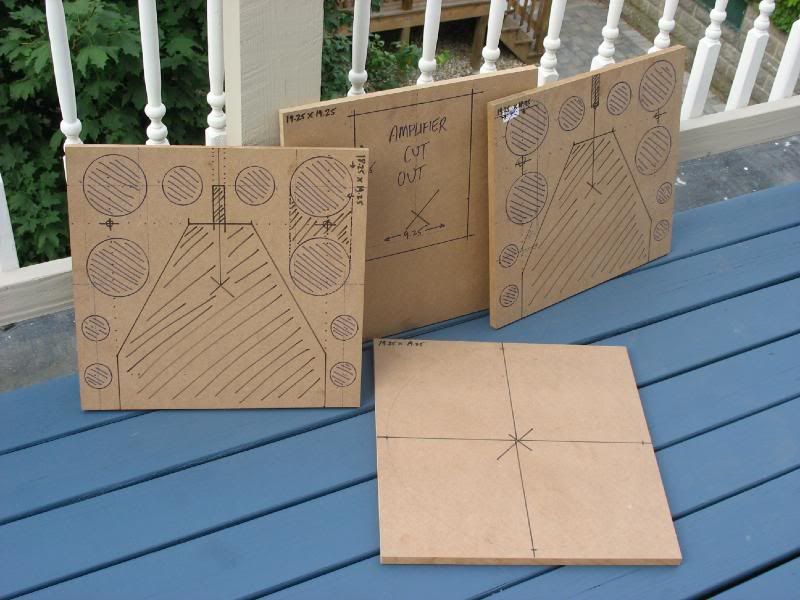
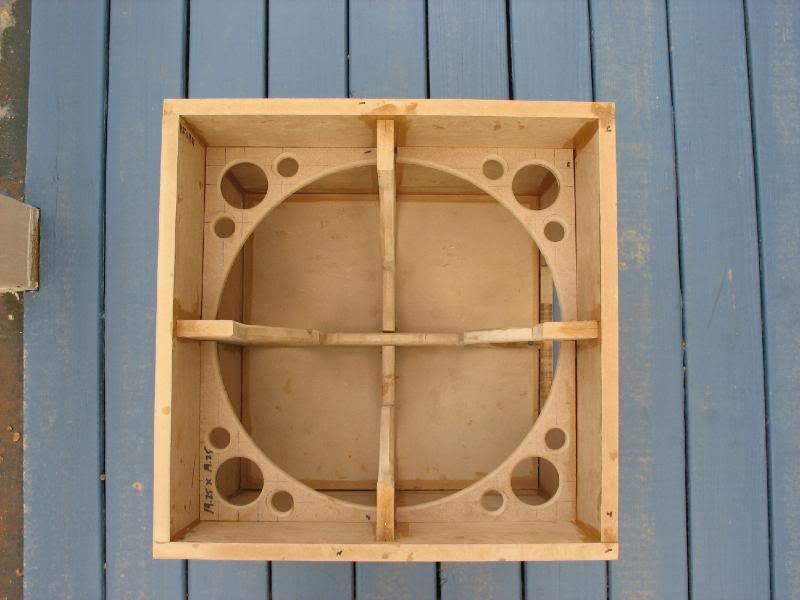
The interior braces of the box, I’m reinforcing on all 3 axis, the cuts and holes you see drawn are for amp/driver displacement, but more importantly air displacement.

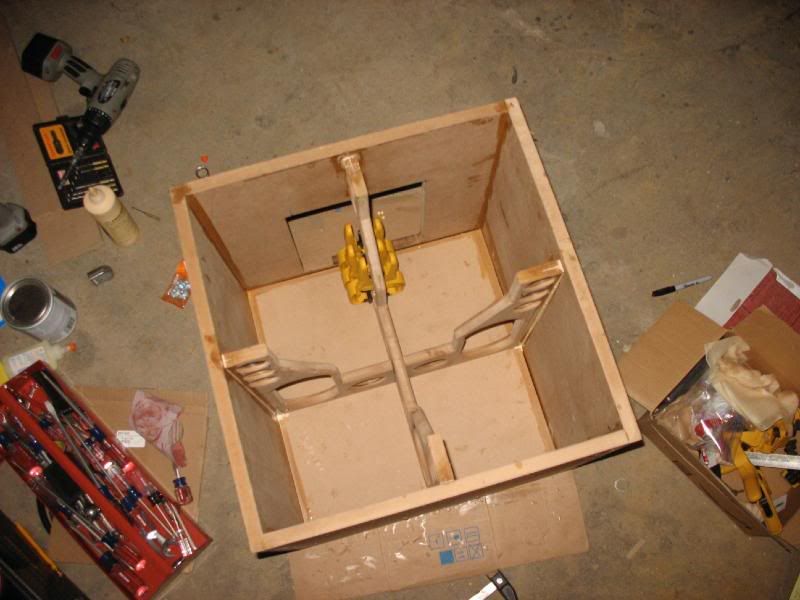
The Glue-Up


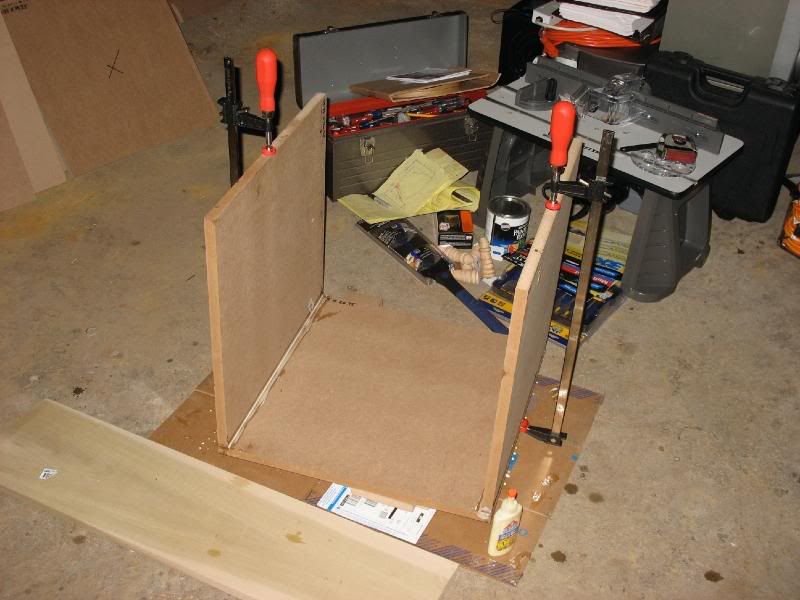
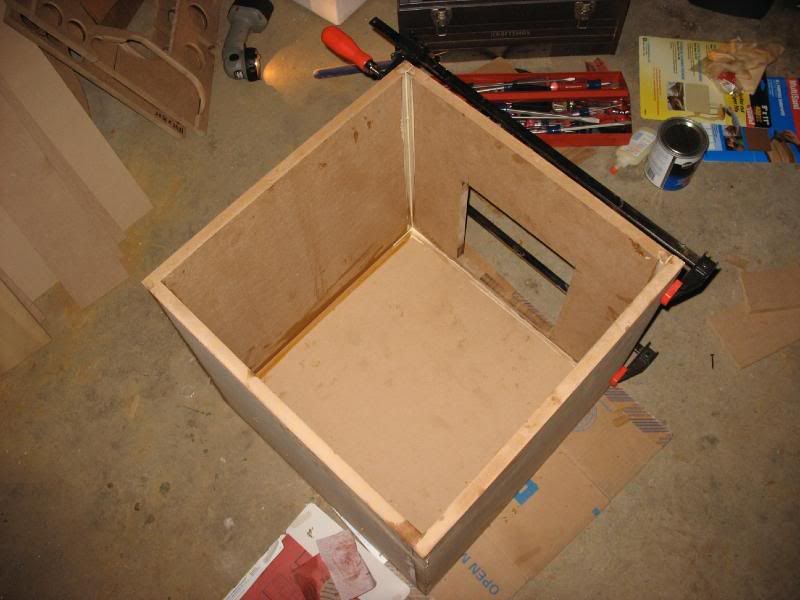
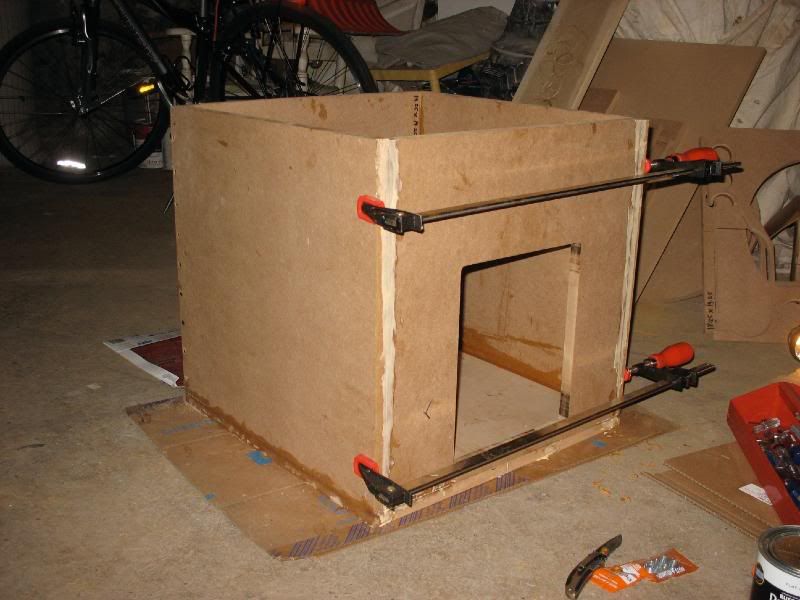
The first Glue-Up!! Representing the sides and top, accordingly. Note: I attached the clamps to hold for a picture, then attached 4 more, you can never have too many clamps!


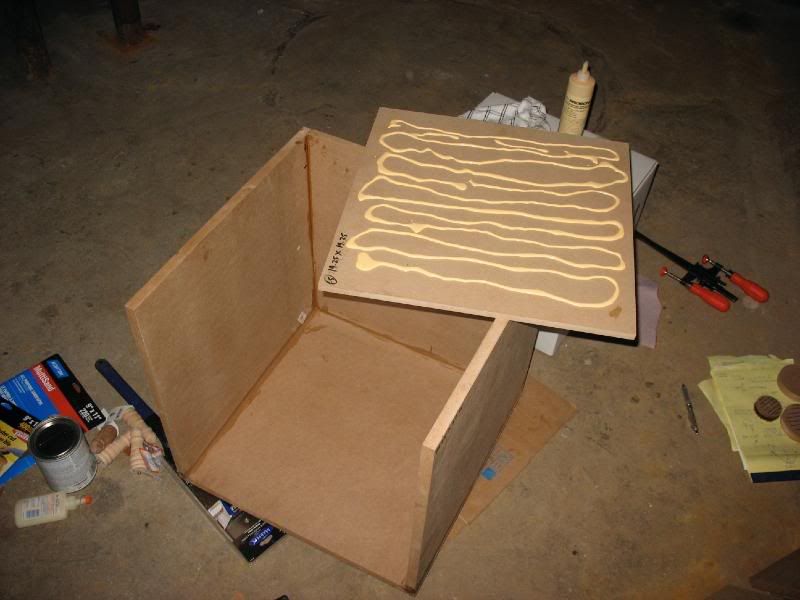
Nor can you ever have too much glue...


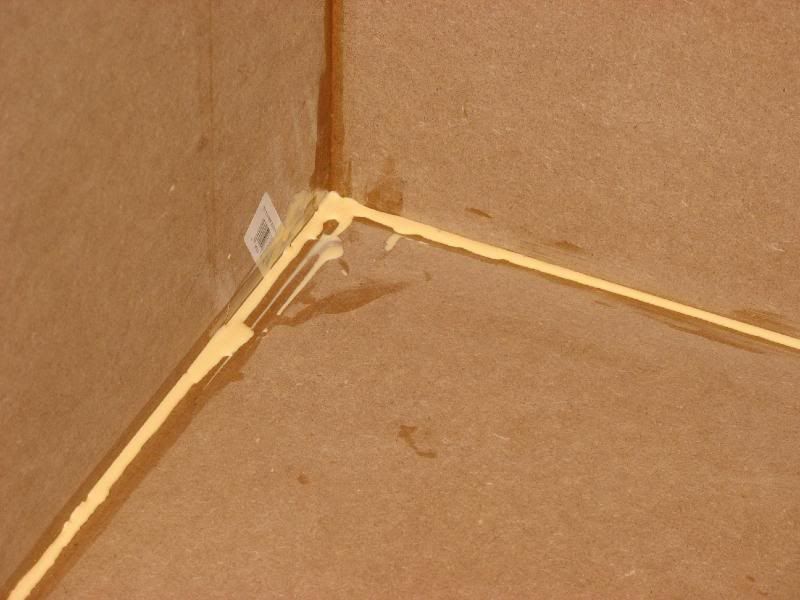
Glue seeping out the edges is a good indicator that you've used enough in speaker building - your box needs to be air tight.

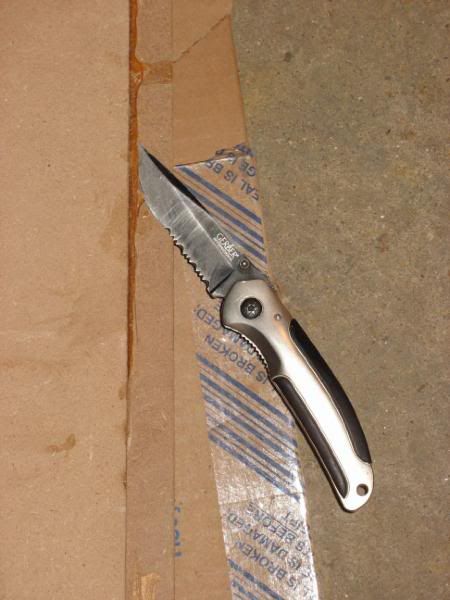
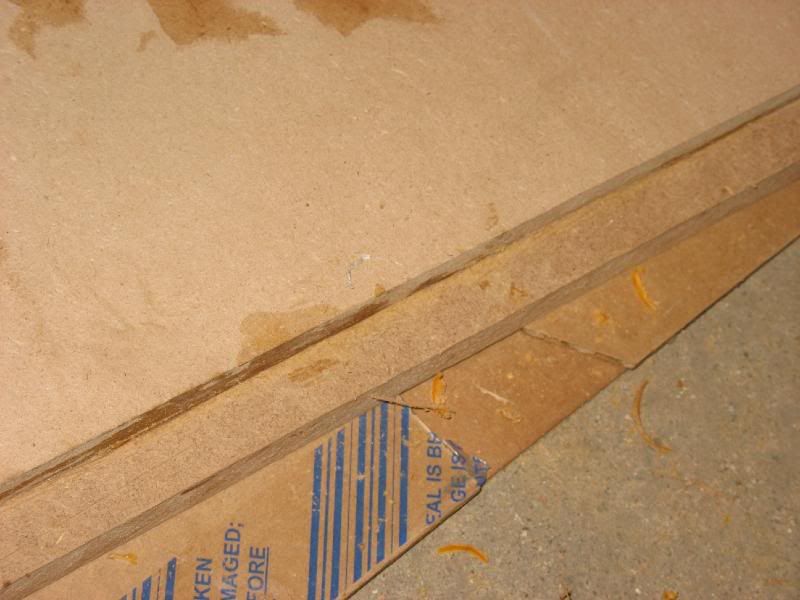
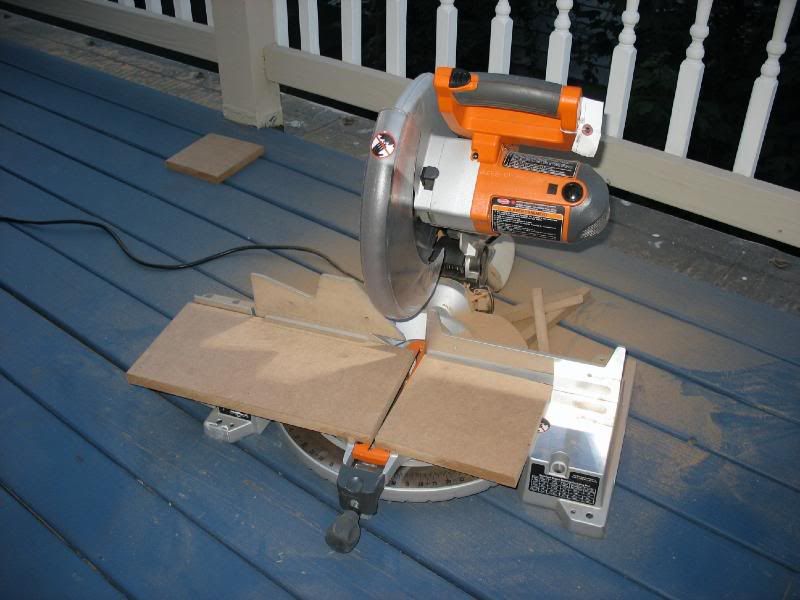
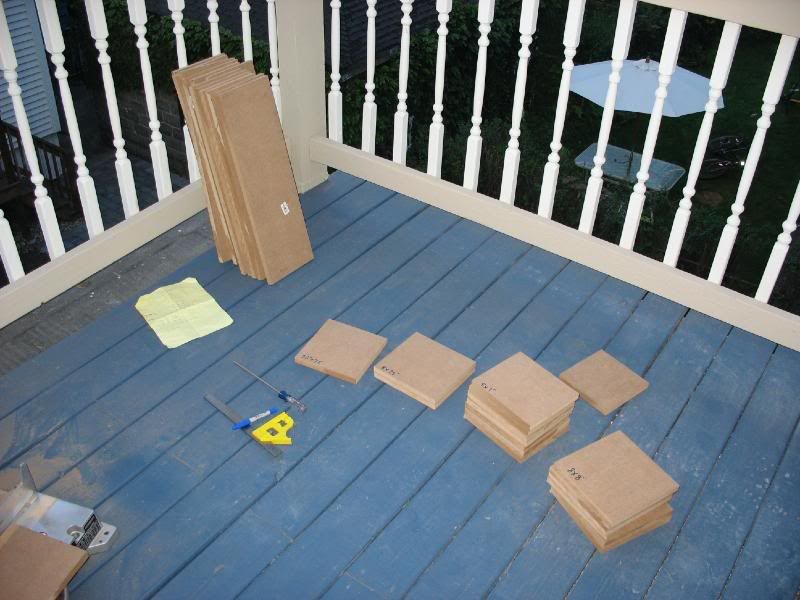
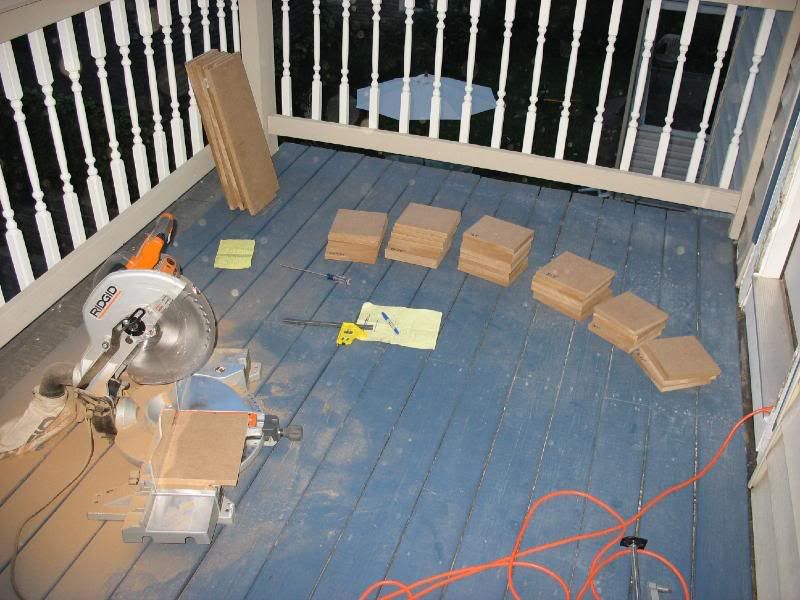
Cutting the Shell


Cutting the Interior Braces


Two of the braces Cut


Legs v1.0. These were the first round of woofer-legs I bought, purchased them from Home Depot and trimmed them for about 3 inches of clearance between the cone and floor. We'll come back to these...


The final trimmed legs


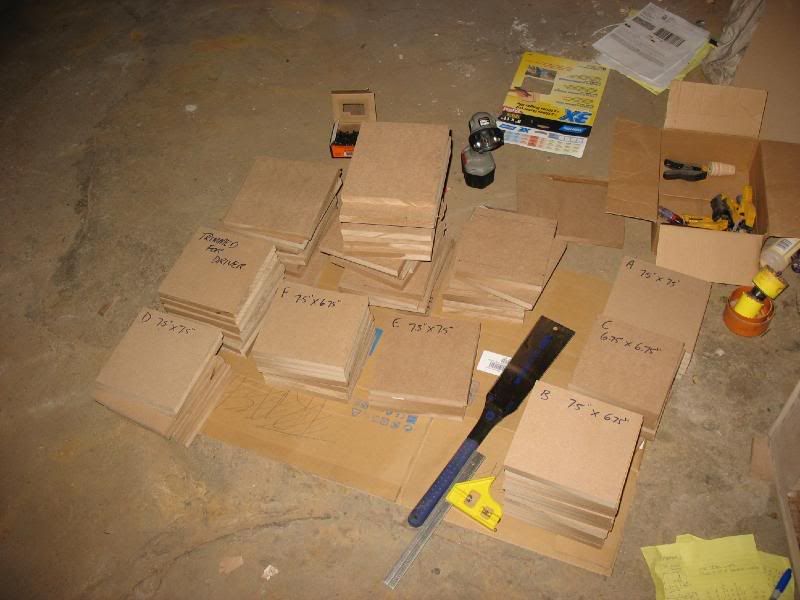
All of the MDF cut to size - Note: the corner bracing is marked where the center brace overlaps, this amount of overlapping must be taken into account when calculating your box volume

According to the Q equations from Rythmik, I need exactly 3 cu. ft of air surrounding the driver. Here's the math:
Total Interior Box Volume:6762.766"^3
Total Volume of Driver: 871.873"^3
Total Volume of Amp: 406.0625"^3
Total Disposable Air: 5484.8305"^3
V of Tall Brace: 263.484"^3
V of Side Brace: 277.922"^3
V of Tall Brace: 263.484"^3
V of overlap on Side Braces: 2.8125"^3
V of overlap on Tall Braces: 2.25"^3
(-) Necessary 3 Cu. Ft of air: 5184"^3
= -498.9965"^3

So, 498.9965"^3 is the net volume of air that must be displaced, save for the 3 calculations below (the base MDF to be removed from each Brace):
V from Tall Brace 1: 102.75"^3
V of Tall Brace 2: 102.75"^3
V of Side Brace: 190.8517"^3

This brings the total volume of MDF that must be removed (after the initial removal) from the braces to: 102.6448"^3


A close up of a corner brace


The interior braces and their air displacement - the goal is to keep them sturdy while still removing wood for air, while keeping the box the target size.


The cut corner braces


The main vertical brace assembled


The main vertical brace with amp cutout

Constructing the Box


Trim away all excess glue when assembling


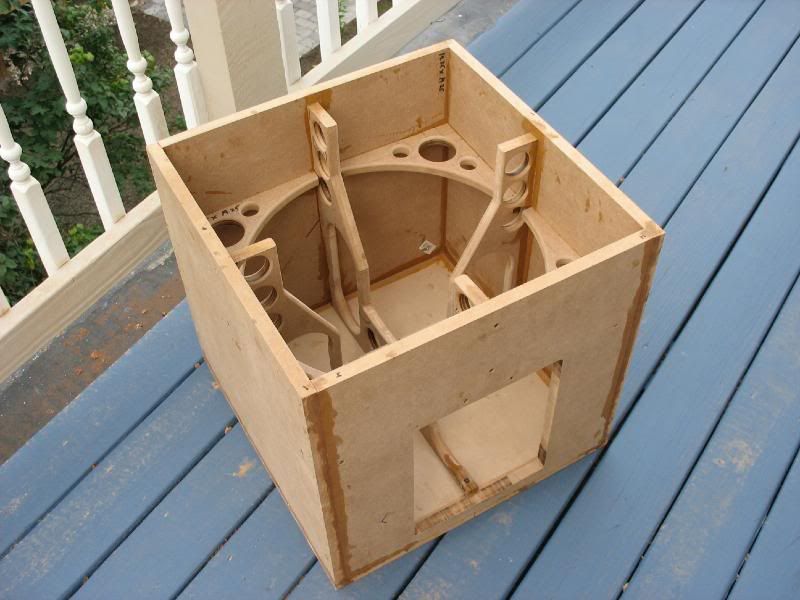
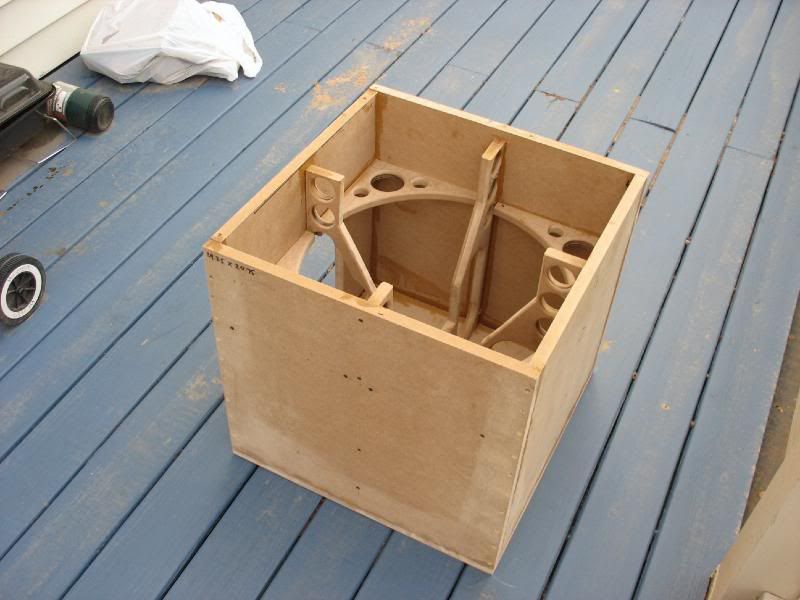
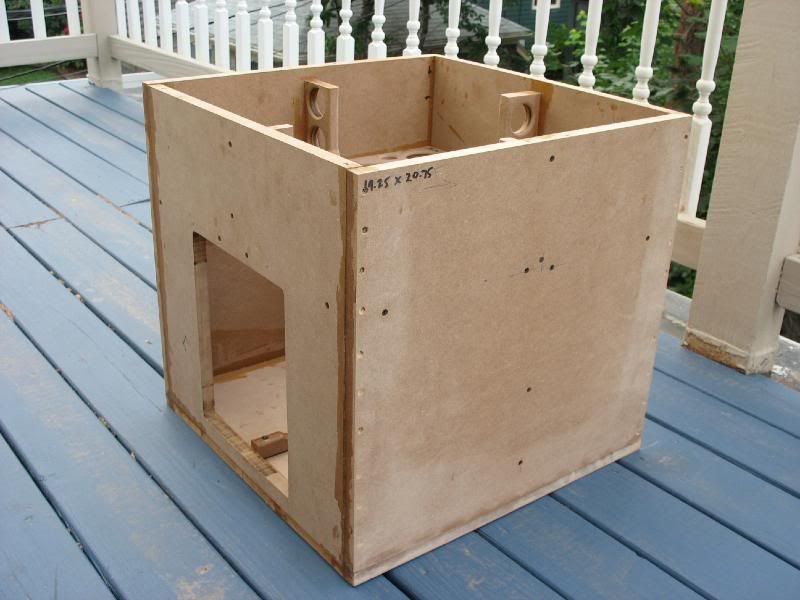
Now, that's a box...


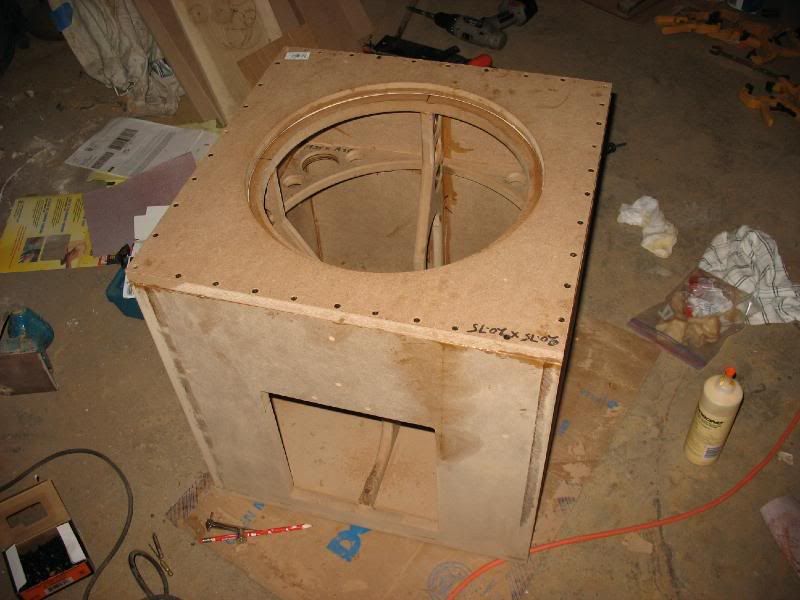
The Amp Side


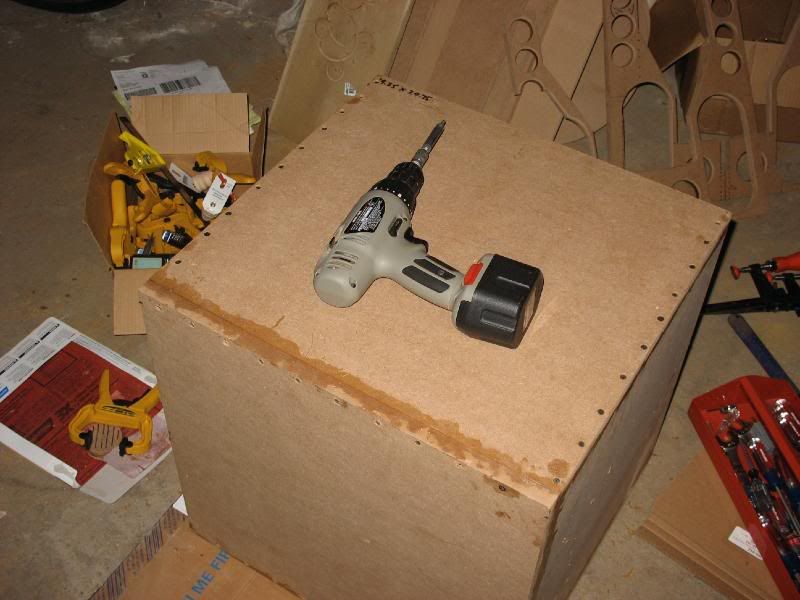
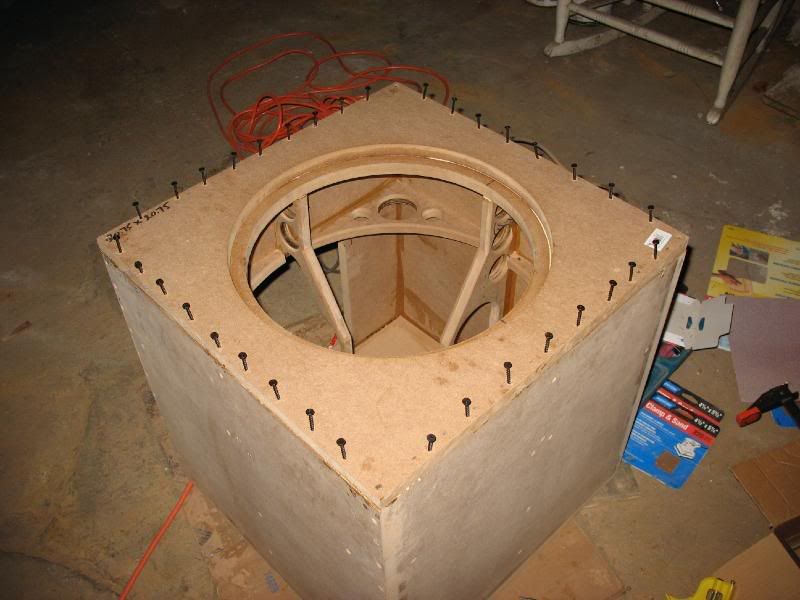
As you can see here, I've attached drywall screws for extra reinforcement. Two things of note: all the screws have been countersunk with the outer edges and I am using these as secondary reinforcement only! Screws cannot be swapped for wood glue.

Reinforcing the Box


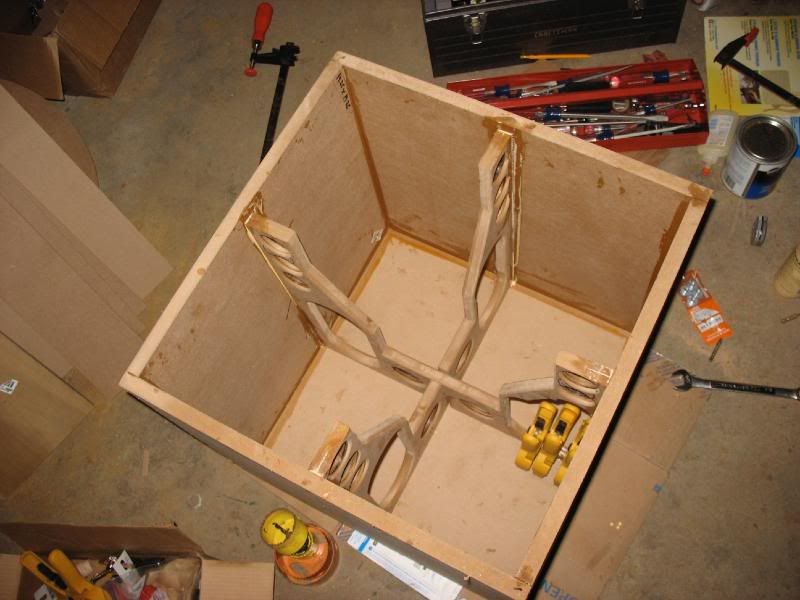
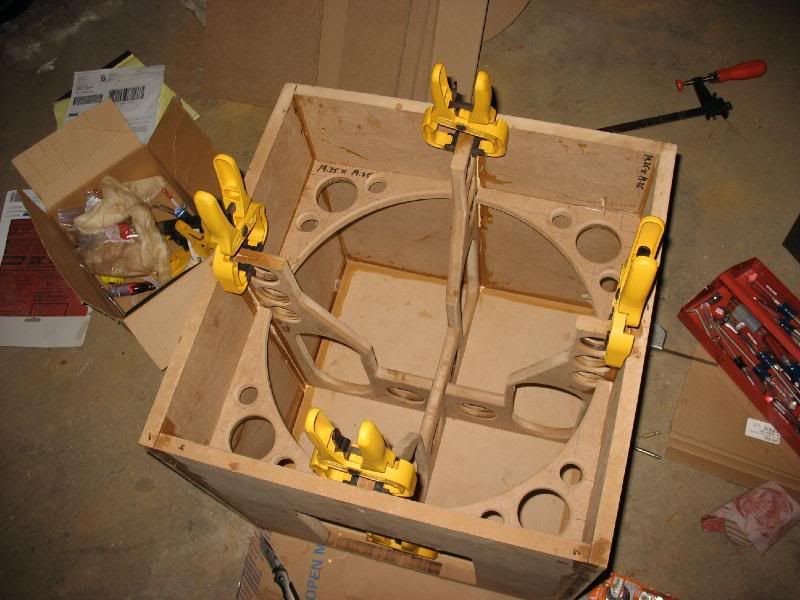
The supports are inserted and glued/screwed to the shell


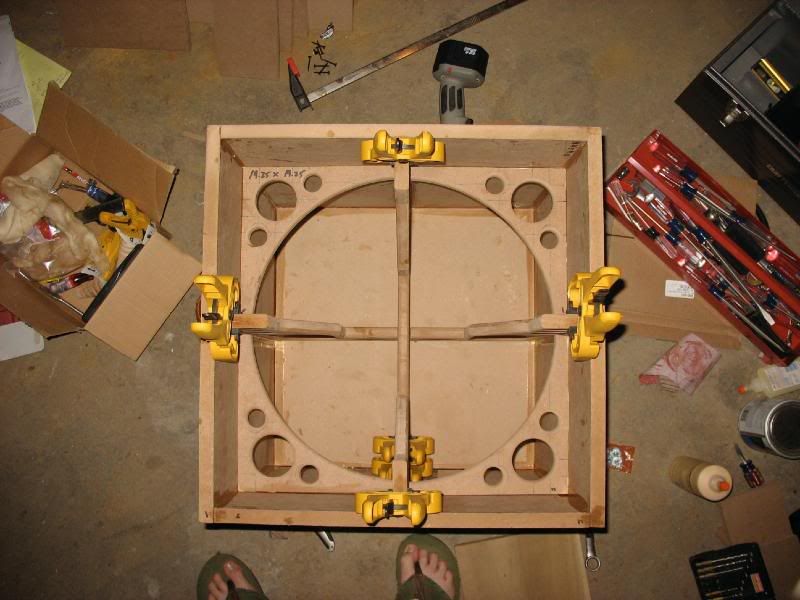
All Y/Z/X supports in place and clamped


At this point my back is starting to hurt...


The reverse bird's eye view. The downward firing driver sits centered over the supports with 1" clearance on all sides - 3" clearance between the driver and amplifier.


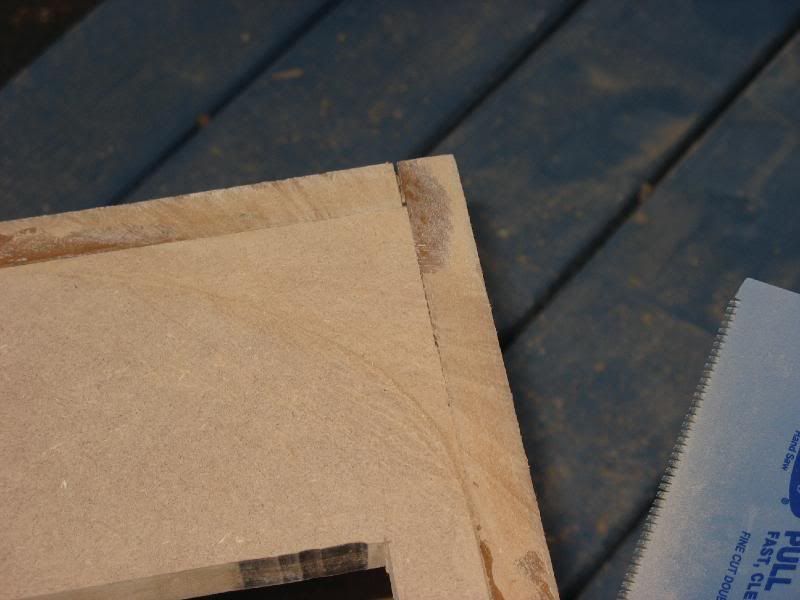
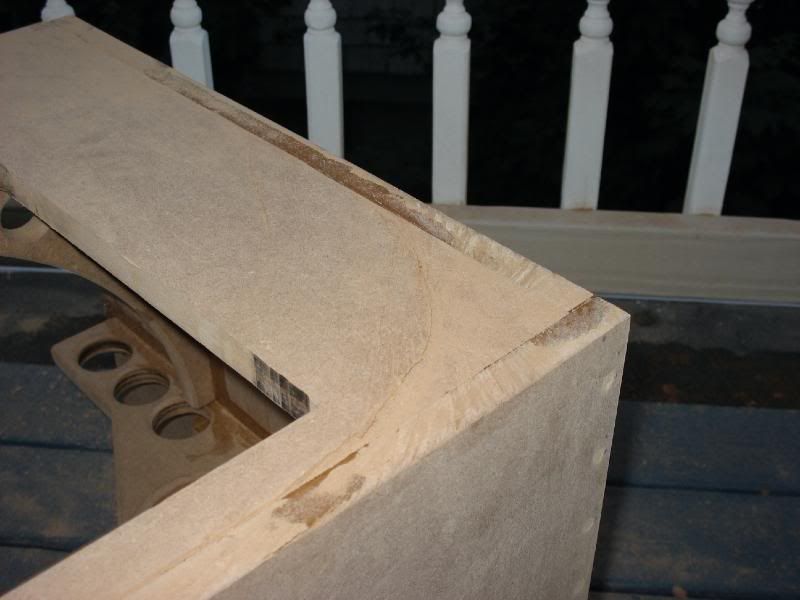
The sanding begins - no matter how exact your cuts are the sides will never line up completely - the excess wood/glue will be sanded off so the tiles will sit flush against the shell


The 4th side to be put on sees all the other side's minute miscalculations - in this case the overhang was high enough to saw it off with my Nokogiri (Japanese-style saw).


1.5 hours later...


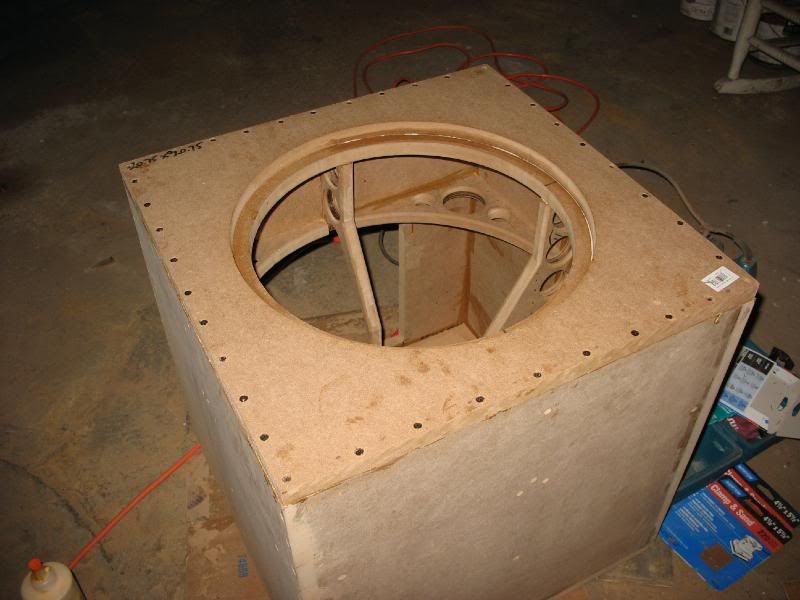
The final two bottoms are put on - the support fits into the box and the outer side fits over the assembly. It's screwed on for extra reinforcement.


Notice the recess for the driver - the outer diameter of the Rythmik DS-15 is 15.5", the same diameter as the circular cut on the outer shell. The inner cut is 14" in diameter allowing a .75" wide surface for attaching the driver.


One completed box.

Plastering


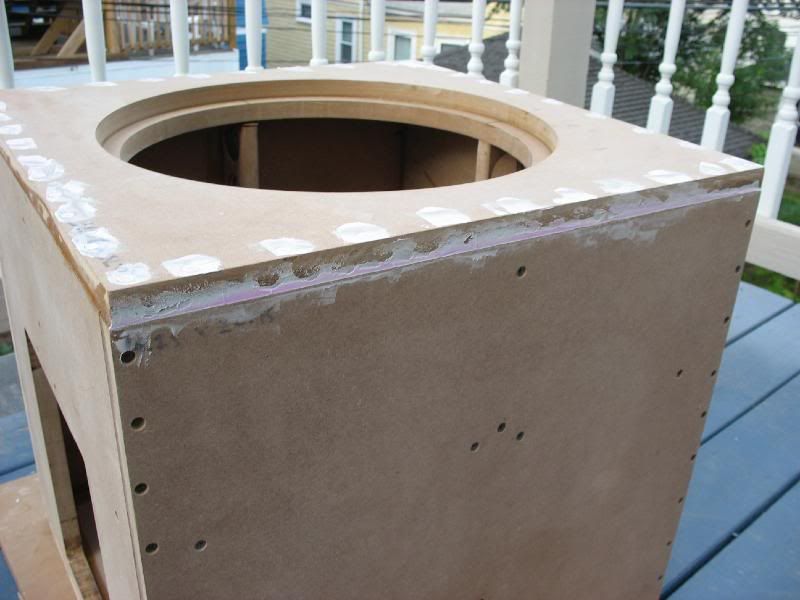
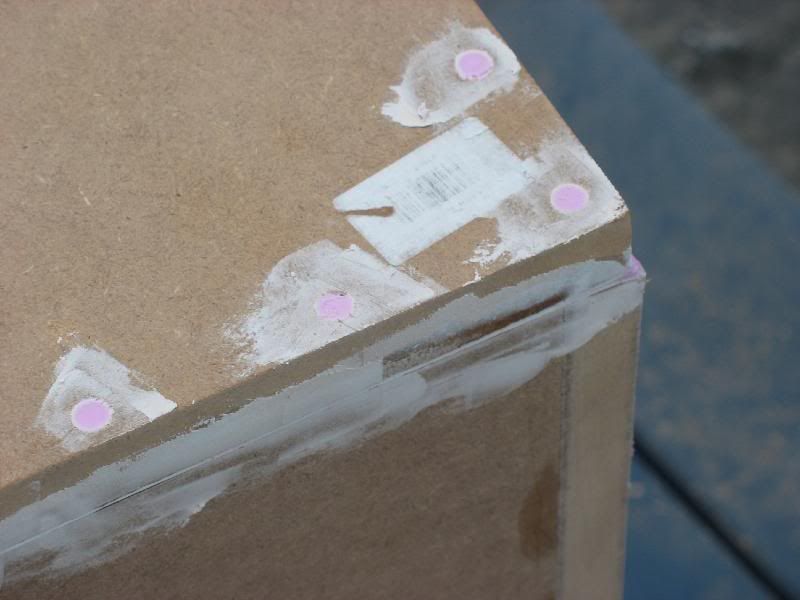
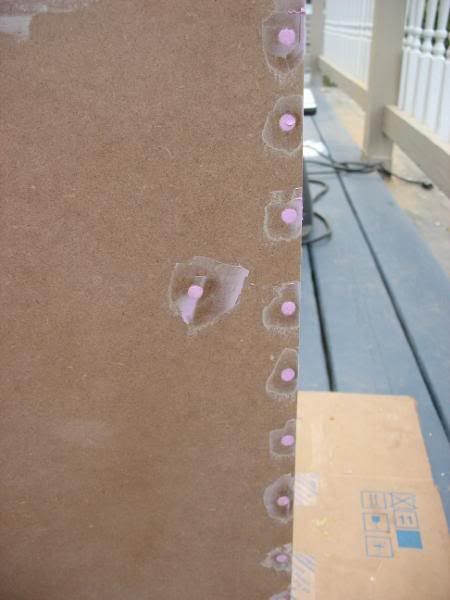
Despite the tile overlay, I want this box completely sealed - all joints, seams, and screw holes are plastered to fill any possible glue holes. I'm using plaster here instead of wood filler because I want it to dry in the joints.


I'm a big fan of the pink-turn-white DAP


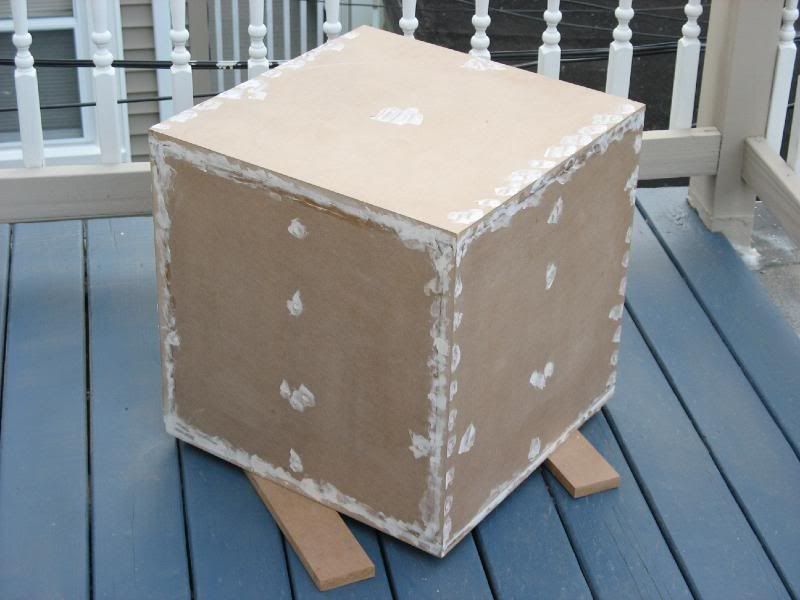
One completely airtight box. Next, sanding it all down...

Cutting the Cube...


Cutting the Tiles


I calculated that in order for the Rubik's cube to maintain scale it needed a 1/2" round-over, however I couldn't accurately cut this on 1/2" MDF. This was when my design partially changed - all tiles needed to be 3/4" MDF in order to accomidate the round-over.


Because the .75" MDF adds an additional .5" to the outer dimensions, the shell needs to be increased in size - otherwise when put end to end the tiles will hang off one side by .5" MDF. Here's the calculation:

20.75" starting surface + 2(.75") MDF tile thickness = 22.25"
22.25" / 3 Rubik's squares = 7.41667" wide
Since I can't accuarately cut that the larger easier 7.5" dimension is used:
7.5" x 3 = 22.5" - 22.25" = .25" = 1/8" increase on all sides.

Where as adding sheets to the Y/Z/X axis would be the easiest solution, I unfortunately can't obtain 1/8" board!! The other flaw with this method is that it leaves no gap between the squares on each surface - inaccurate to scale.

*PLAN B*
Instead of adding 1/4" to all sides, I instead added 1/4" to each side. This increases the dimensions of the box to 21.25" all around.
7.5" x 3 = 22.5" for the outer dimensions of the bare tiles and (20.75" + 2(.75) + 2(.25)) for the total dimensions leaves .25" for two gaps, or 1/8" gap between all tiles on all sides, fitting the scale.

Problem Solved.
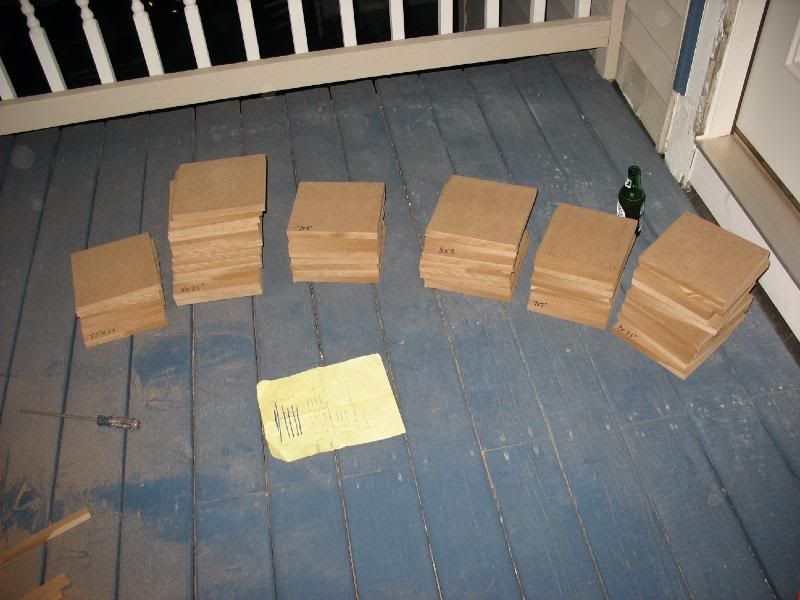

53 Cut tiles


Plus 20 extras...

Assembling the Outer Cube


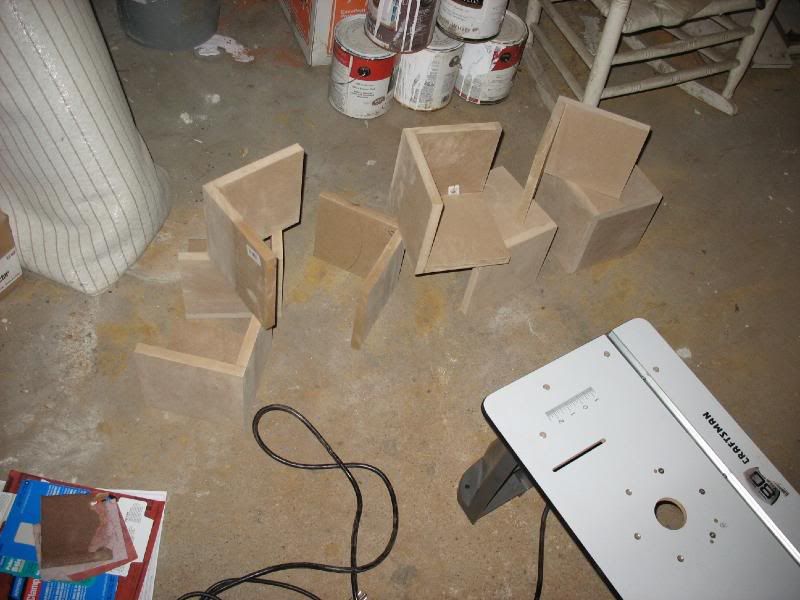
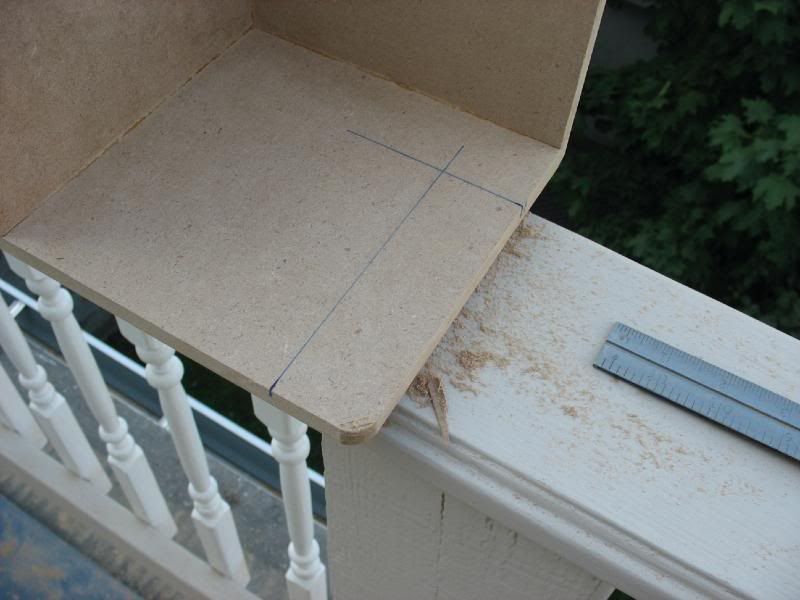
Tile Assembly. Done in the same fashion as the shell - all butt joints cut short on certain sides by .75 inches so the tiles line up into perfect squares. Once finished they're going to be sanded , plastered, and then sanded again.


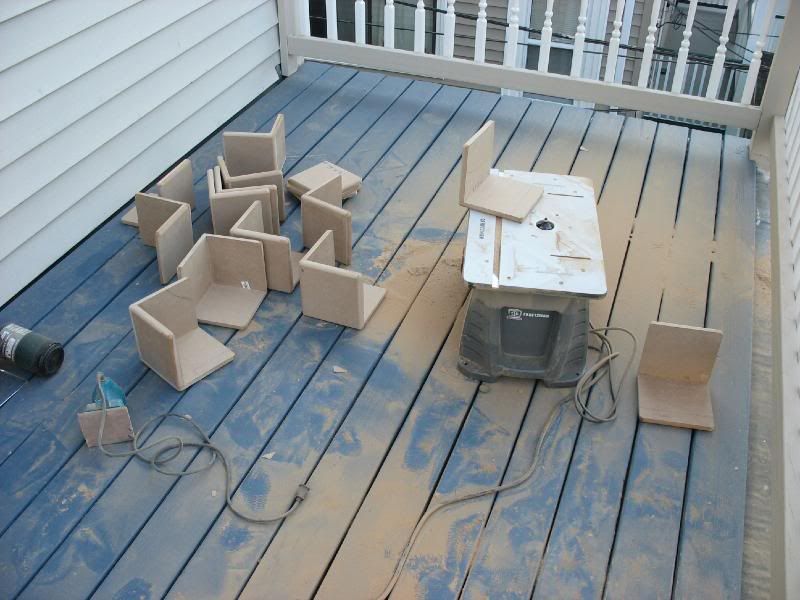
Corners and sides assembled before routing


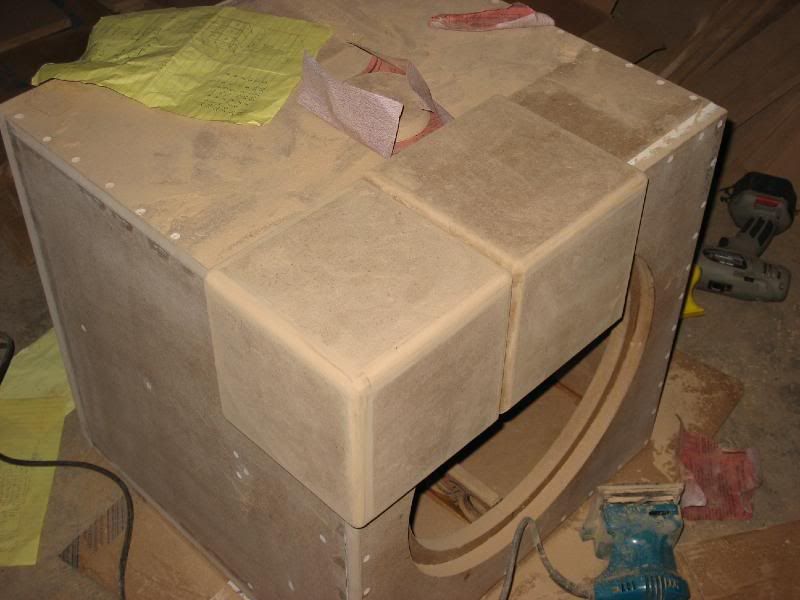
The two prototype tiles - I finalized one corner and side before doing the rest to verify my method - I think they turned out pretty well!


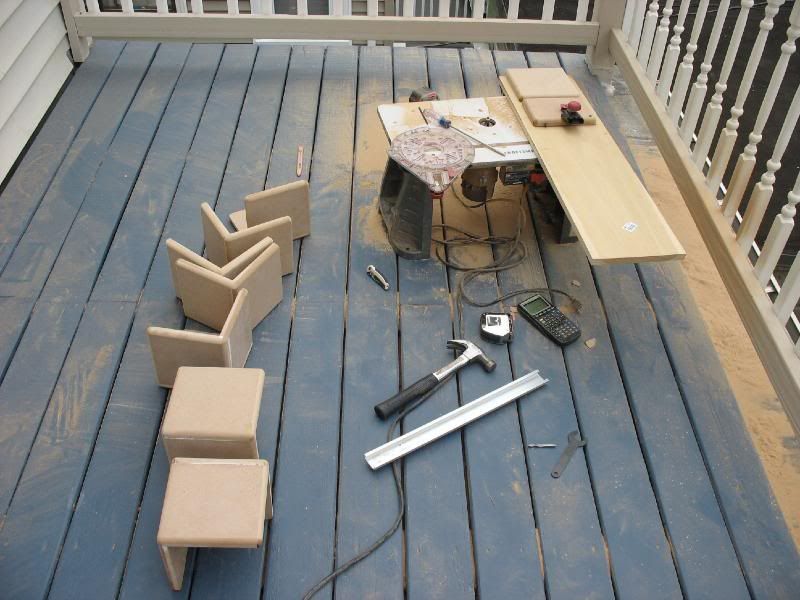
Routing the tiles with the 1/2" round over bit on my routing table - absolutely necessary for this type of work.


5 tiles need to be trimmed for the amplifier and 8 need to be cut for driver. This piece is backing the top right corner of the amplifier. The cut will be made with my Nokogiri and then routed down.


The first set of tiles rounded over with the driver cutting assembly


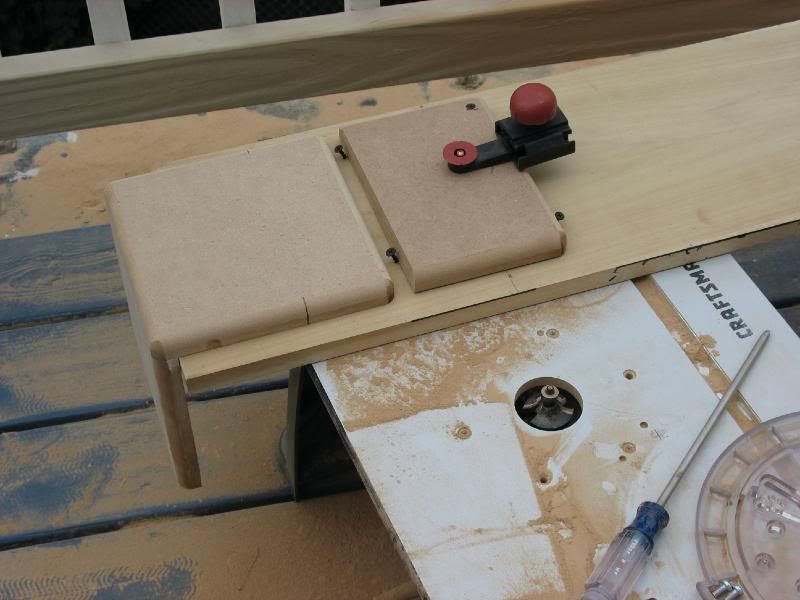
In order to cut the circle for the driver into the tiles I attached some scrap wood to my routing table. I then attached my circle cutting jig to one piece and measured a 7.5" radius from the pivot point to where the driver would sit against the tile. Rinse and repeat 8 times.


Dry fitting all the newly cut tiles. All tiles need the same plastering as the shell for cosmetic reasons - painting and sanding will make you forget you're looking at wood...

Finishing the Tiles


Painting and priming the tiles. I'm priming them in titanium white so the black will pop rather than soak into the wood grain.


Once painted, the tiles are sanded with 400 grit and tacked for a plastic sheen


Once sanded, spray it black.

Feet v1.0


Getting back to the feet, pretty self explanatory, just sanding and painting...


Finishing off the Shell


The driver and amplifier openings are painted black just for sealing purposes - neither of these will be seen


As mentioned above, here's the shell with the 1/4" extensions on all sides. Each of the joints in between the slats are plastered, just in case. All are painted since the color will be visible. The slats, rather than covering the entire surface, have been positioned to straddle the tile seams - there are a few inches on both sides for the tiles to adhere fully.

Tile Assembly


All slats are painted before any tiles are adhered.


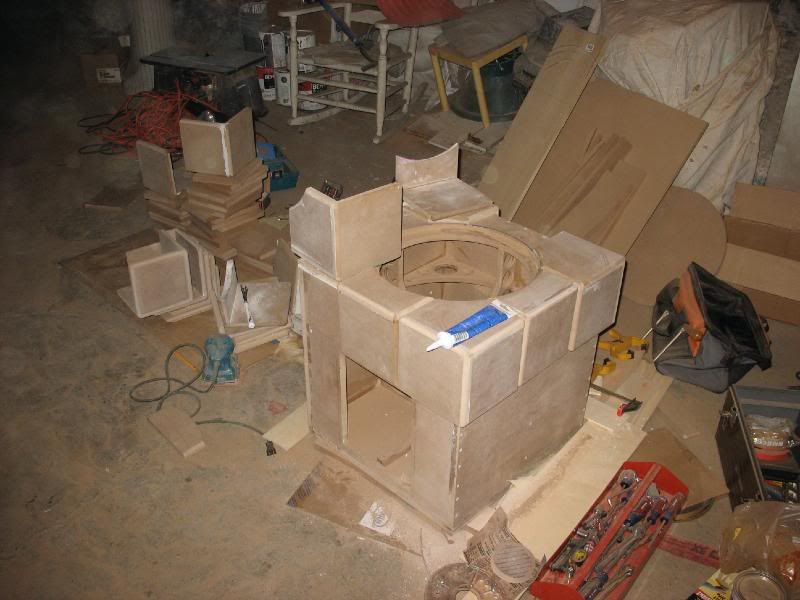
The corners are put on first - this allows floating space between the two so the center tiles can be evenly spaced.


The cut out tiles and amp - they were etched true to the shell opening


'Cover the entire surface and make Norm happy.'


A fully completed side - finalized backing color and spacing.


Nearly all sides complete - it's now so heavy that i can't lift it without stretching first...~120 lbs.


The last picture taken at the old apartment - the new apartment will see the final painting...

The First Round of Painting


New apartment! After taking a couple weeks break to set up the new place, I can resume. In order to paint the proper size colored square on the cube, I made a jig to scale and taped/cut over it on all 53 squares. Notice I have painted the background first and then put the color on top of this - this is because I want the color to really pop off the background. Putting a few coats of paint on the surface will make it appear as though it is on top of the background rather than a part of it. This is meant to simulate the adhesive stickers placed on the puzzle 1/10 it's size.


Completely taped, making sure to cover all surfaces from over spray


Completely painted - let it dry overnight and peel it off in the morning, if you've sealed your tape properly then it should work just fine...


The prototype side completely painted. I've decided to put red on top. Seeing my art, 60 days work thus far, take shape is the ultimate rush for me...

Painting the Amp Side


The amplifier side - I've decided to make this side orange


Taped and painted in the same manner as the top side.


The completed (orange) amplifier side. Looks pretty good.

Painting the Driver Side


The bottom driver side - I've decided to paint this side yellow as it's my least favorite color on the Rubik's cube - looks damn good against the black though...


I knew getting a nice round edge next to the driver was going to be tough - I played around with ideas for a few days before I settled on a method I thought I'd try. Turns out it didn't work, I knew I was going to need something round that I could use as a guide to make the driver cutout into the colored squares. By sheer chance, I own a clock that happens to be the exact same diameter as the driver - worked as a perfect guide for that nice round edge. It's really the only way, I also tried free handing before clocking - the tape and the results weren't nearly as good.


Now back to v1.0 of the legs I mentioned earlier. My original design called for these legs to be attached via T-nuts into the tiles. As i was saying, the weight of the sub by now is around ~120 lbs. After attaching the legs and seeing the wobbly T-nuts i knew these things weren't going to stand a chance. After flipping it over and nudging it, 2 of them ripped out without effort. Despite matching the funky theme, I made the decision to swap them out - only 2 design changes during building - not too bad.


The attached T-nut that later ripped out, ha

The Final Painting


The white side gets painted


and the blue side...


the green side finished...


It goes very fast in the pictures, but the taping alone on of these sides took 3.5 hours...


One completed, painted, box.

Stuffing Party!


I found that around .75 lbs of poly-fil/1 cu. ft of air sufficed nicely. As I've said, my box has been extensively measured to have as close to 3 cu. ft of air as possible but, in reality, is a tiny bit small. When boxes are too small the sound waves from the driver will hit the walls and bounce too quickly. This causes reverberation, rattles, and ultimately ugly sounding bass. This can be fought through stuffing - the goal here is to slow down the sound waves through the box and trick it into thinking it's bigger than it is.


One completed, painted, and stuffed box.


I have used 1/8" x 3/8" closed cell rubber gasket around the side and underneath the cone and basket. This is absolutely necessary to forming an air tight seal on the box. This is also where the painting comes in handy - by applying it you are filling any tiny surface abrasions that act as holes in your seal.


The driver screwed in and sealed to the shell - when screwing into the rubber gasket tape, it's not uncommon to have to circle back and tighten screws as the rubber expands in certain areas, the drilling/screwing/leveling process should be handled with extreme precision - I spent all afternoon doing this... Notice the Ryhtmik DS-15 has a rubber O-ring around the base of the basket - these types of rings are generally used in car applications. I decided to keep this one on for cosmetic reasons - it helped cover up the shell/tile joint.


The woofer with the driver and amp screwed into place on the shell (not the tiles) with v1.0 feet. It was shortly after this photo was taken that I realized I needed more structurally-sufficient feet.

10.10.2007

Feet v2.0


The new legs to be put on - notice I'm keeping the same vertical clearance but increasing the surface area by 5. With 4 high-load capacity bun feet, I think we'll be safe up to and beyond the weight of the sub. I'm attaching them with 3 inch wood screws through the tiles and into the shell, but NOT into the interior! Just to be safe however, I am lining all the feet with same closed cell rubber gasket before anchoring down.


The new feet will line up with the outer corners over the existing feet locations


Pretty menacing...


Finished.

Do we dare call her finished? Also if you haven't noticed by now, the light sucks in nearly every location I've had to take these, apologies for the photos - perhaps if there was professional out there who wanted to help a guy out?...


Testing and Conclusion

I don't own any professional audio testing equipment but I wish I did: I'd LOVE to see this baby's numbers - her maiden voyage saw my 3 tests I put all my audio components through - Diva Plavalaguna from The Fifth Element (if you test speakers, you know the scene i mean), Massive Attack's Angel, and Thomas Bangalter's Rectum.

I did a side by side with 3 configurations from the T773 - the cross set to 200hz, 80hz, and 40hz with the fronts and rears set to small in order to hear the bass channeling. The only real competition to the sub however is the fronts so those were the ones i really concentrated on.

I should also point out that the Rythmik Audio AS370 12dB/Octave Amplifier I purchased has customizable settings for a low pass filter and damping factor - VERY handy when fighting cone excursion and clipping. Through my tests i set my amplifier on the DS-15 to a 14hz low pass filter and a high damping factor. The low pass filter acts exactly how one would expect it to work and the damping factor steepens the curve of filtration on the low end. While I would normally want something less harsh, on a 15" bass driver you're going to lose quality quicker than on a 4" mid range.

200hz Cross - Stereo - Playing Massive Attack's Angel provides a good indication of the speakers power handling/filtering/as well as the CD players discrete processing (the track features simultaneous, sharp, tweeter and woofer signal), since none of that is on trial here however, i concentrated on the balance between the sub and full range fronts - I wanted to see how the woofer handled the low end next to the high and mid range that i'm so used to hearing on the Studio-100s.
Though i love my fronts i never realized they rolled off like that - haha. The DS-15 handled itself beautifully, no signs cone excursion. The driver appeared to be a little over driven on the part of the crossover freq, so i tuned it down.

80hz Cross - Stereo - My fronts tend to lose a lil' bit of their bite at freqs around 40hz. The 80hz mark saw everything i dreamed of in a sub - The bass was smooth and clean and after adjusting the phase on the amplifier one couldn't tell the low end on the fronts from the bass. The mid and high end popped over the sub and sounded excellent - complete coverage of the spectrum.

40hz Cross - Stereo - This is really where i want to keep the sub, using the fronts (while still set to 'small' on the T773) full range and keeping the sub for the freqs unheard on the fronts. Where as i expected separation issues and a distorted 40 - 200hz range with the cross tuned so low, i actually received a velvety smooth low end from music that i never knew had that kind of bass. The music sounded rounder, complete, and more dynamic - listening to the full range on the fronts still sounds GREAT but the 'real kick you in the stomach' bass from the DS-15 went perfectly with it. I gotta admit, I'm a puritan and want to stay off the sub for CD playback but I don't think I'm going to be able to...


Now getting down to what I'm sure everyone is wondering - the cost. Did my Rubik's cube project end up saving me money over buying a brand new similar sub? Why yes, yes it did if you read directly from the MSRP of such subwoofers. For the deal that I probably could've received, i really only saved a couple hundred dollars. Granted the bulk of the cost were tools and the way i rationalized it was the tools i purchased would have to be bought sooner or later. Taking that $428.98 cost off the table, the total i spent on materials/supplies was $284.74, not including the driver/amp at a cost of $578.55.

Making my combined total spent on the Rubik's Cube subwoofer: $1586.08

Compared to the MSRP of subs in it's category, all i can say is 'What a Deal!' Compared to what i probably could have purchased one for i did pretty well but of course i had the pleasure of customizing however i wanted. In Conclusion: the DS-15 comes highly recommended! For the money spent and the quality received, you'd be foolish not to investigate!

I'd like to thank Melissa Bazillion with helping to get this site launched and while you're here please give me a comment or send me an email with any questions....


Thanks for visiting!